
Implementation speed starts with how the plan is reviewed
At AEKO, the most important work for building features quickly and reliably happens before implementation. Instead of asking one agent to plan and build everything, we generate plans from multiple perspectives, consolidate them, and let a human review the actual user flow.
A long planning document can hide relationships between screens, missing states, and ambiguous transitions. We therefore turn the consolidated plan into a visual artifact that a human can inspect before code is written.
AEKO's planning orchestration
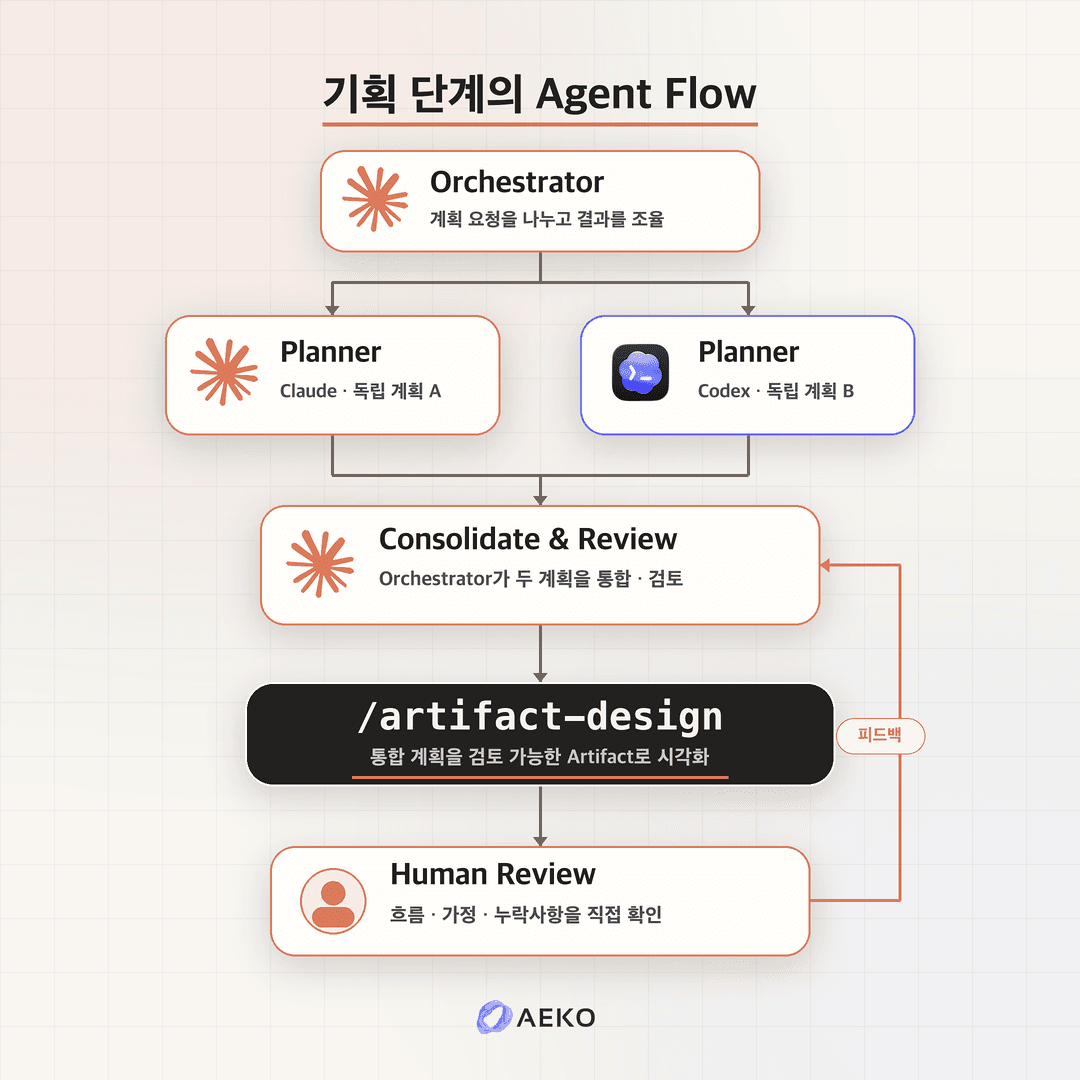
The orchestrator first asks Claude and Codex to approach the feature plan from different angles. It identifies shared direction and conflicting assumptions, then consolidates the implementation sequence and validation criteria. The team uses its custom /artifact-design workflow in Claude Code to visualize the resulting screens and interactions.
/artifact-design makes the plan visible
/artifact-design does not perform the human review. Its role is to turn the consolidated plan into something reviewable, such as a visual flow, interface, or interactive artifact. Human review is the separate final step in the planning loop.
That distinction matters because implementation logic and user experience are different questions. An agent can produce a logically complete plan, while a person viewing the flow may notice where users hesitate, what context is missing, or which transition feels unnatural.
What the human reviews
- User flow: Is the next action clear from entry to completion?
- States and exceptions: Are loading, empty, error, and permission states covered?
- Assumptions: Which requirements did the two planners interpret differently?
- Acceptance criteria: What evidence will show that implementation is complete?
Agents and humans notice different things
AEKO combines this process with several custom skills for specific engineering tasks. But seeing the feature at the planning stage remains a basic quality practice.
The value comes from separating roles. Agents expand the solution space and make plans concrete. The orchestrator consolidates their work. The artifact makes the plan inspectable. The human makes the final judgment about product direction and user experience.